Rivers
A river runs one way, but its level, speed and what it carries change through the year. A unit here has to stay stable in a confined channel and cope with debris and shifting depth.
NEXUS HYDRO LLC develops semi-submersible units with vertical-axis water turbines that turn river and ocean currents into electricity. There is no dam and no reservoir: the unit sits in the flow and works with it.
Each unit combines a turbine, a system that speeds up the water reaching it, and a floating structure that holds it all in the current. We research, design and test all three.
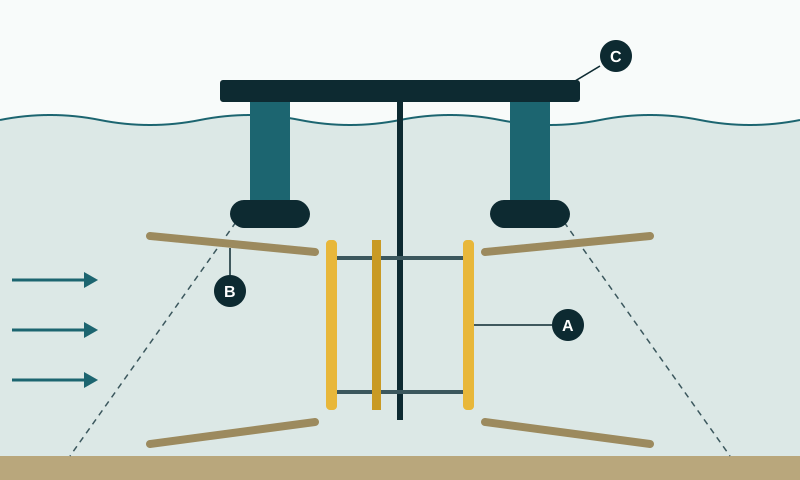
The blades turn around a vertical shaft, so the rotor takes water from any direction without having to be turned to face it. That matters wherever currents shift or reverse.
Guides shape the water around the rotor to raise its speed through the blades. The energy in a current climbs steeply with its speed, so even modest gains in velocity are worth the engineering.
The structure rides largely below the surface, which keeps it steady and holds the turbine at a working depth inside the current rather than on top of it.
We design for both. The physics is shared; the conditions a unit has to survive are not.
A river runs one way, but its level, speed and what it carries change through the year. A unit here has to stay stable in a confined channel and cope with debris and shifting depth.
Open-water currents are broad and can change direction. The design has to handle waves, salt water and loads arriving from more than one side, which is one reason we build around a vertical-axis rotor.
In both, the unit works inside the flow instead of holding the water back.
Research, design and testing run as one loop, applied to turbines, flow acceleration systems and floating structures alike.
We study how water moves around rotors, guides and floating hulls, and what the currents at a given kind of site actually look like.
Turbine, flow acceleration and float are designed together, so a change to one part is checked against the other two before it goes further.
Designs are tested to see how they behave in moving water. What the tests show is measured against what the design predicted.
Test results go back into research, and the loop starts again.
Registration and contact details for partners, suppliers and anyone who needs to confirm who we are.
Questions about our turbine, flow acceleration or floating structure work: send a message, or write to us directly.
Your message passed the checks. This page does not send form messages, so please email it to andreisbruno843@gmail.com to make sure it reaches us.